
Crowdsourcing the Decipherment of Canadian History
Table of Contents
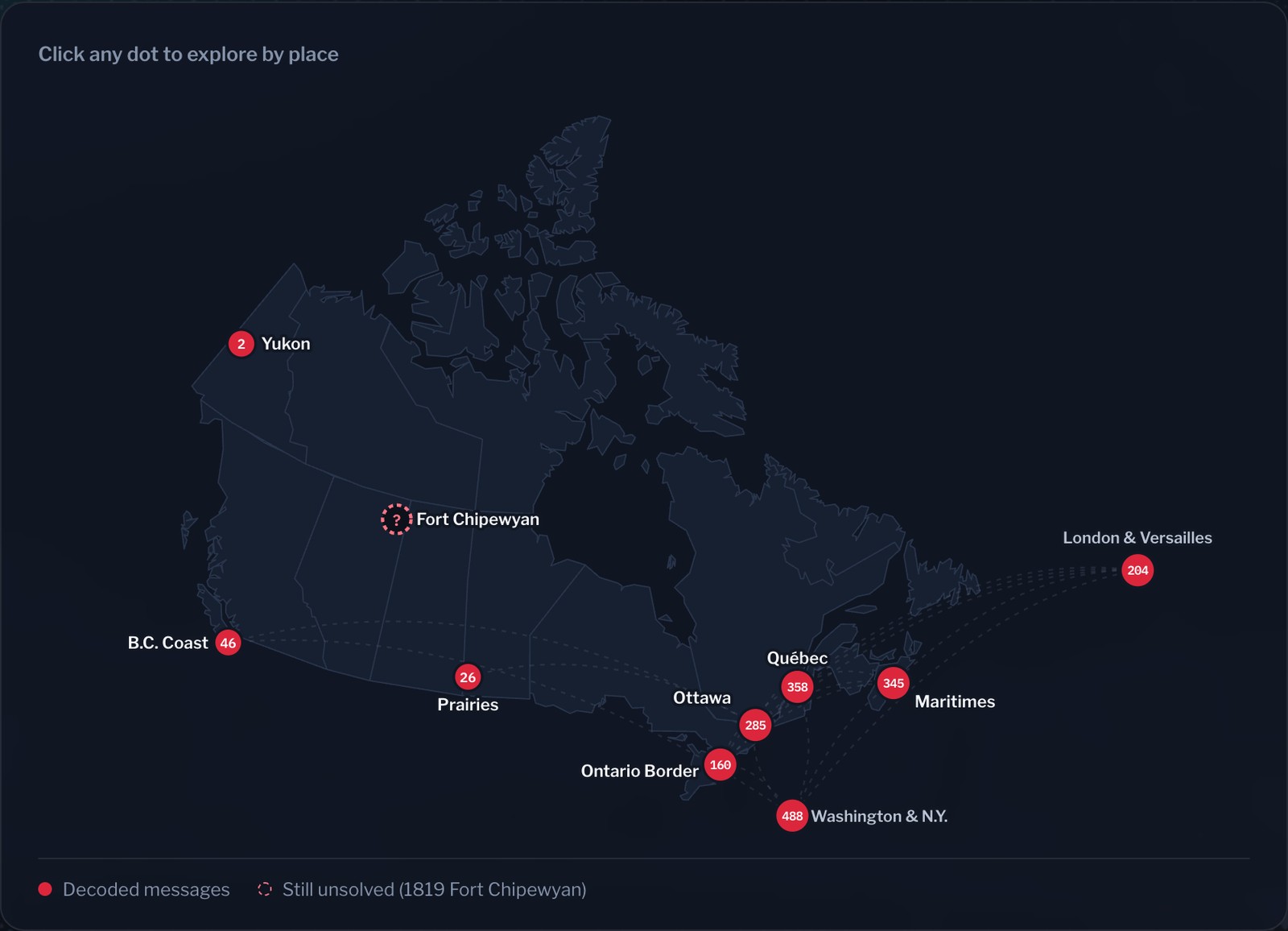
I put together Undeciphered.ca, a small open archive of coded letters and telegrams from Canadian history (1673 to 1945), and opened it up for crowdsourcing. Both humans and coding agents can submit solves, newly found archival ciphers, or corrections.
Explore Undeciphered.ca | Open Challenges & Leaderboard | GitHub
Why crowdsource it
Earlier this year I wrote a quick note on how cheap tokens change public records. Digitized collections at Library and Archives Canada, Heritage Canadiana, BAnQ, ANOM, and the Hudson’s Bay Company Archives hold far more coded telegrams, colonial dispatches, and old newspaper ciphers sitting unindexed in scanned boxes than one person will ever find or check alone.
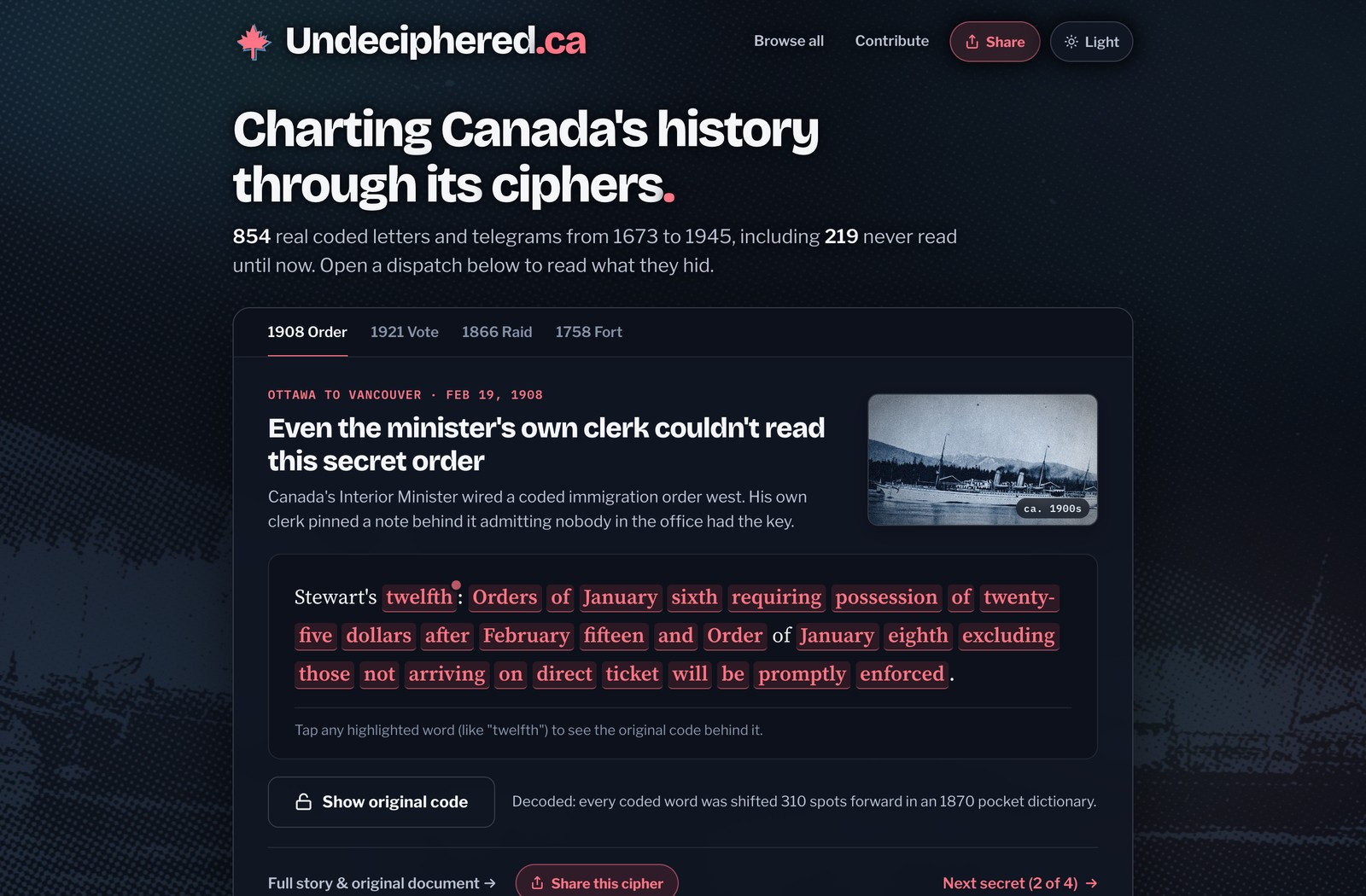
Many Canadian government wires from 1873 to 1936 are surprisingly approachable once you know the pattern: six Prime Ministers reused Robert Slater’s 1870 pocket telegraph dictionary with simple constant word shifts (for example, this 1908 wire from Frank Oliver shifts every codeword by 310 entries). Others use older French nomenclators, border-era route ciphers, or personal wartime tables.
The interesting part now is surfacing what is still hidden in the boxes and finishing the records that are still stuck.
What is open right now
- Colin Robertson’s 1819 Fort Chipewyan cipher: Written during the Hudson’s Bay Company and North West Company fur-trade conflict in northern Alberta. Still unsolved.
- Unsolved border and Confederation wires: Two Macdonald-era telegrams (1890 and 1891) and an 1864 Civil War border intelligence cable.
- Partial decodes with missing pieces: Including an 1890 five-digit Bering Sea diplomatic cable and a 1942 handwritten numeric cipher from Hamilton, Ontario to J. Edgar Hoover (currently 92% decoded).
- New archival finds: Any coded Canadian letter, government cable, or newspaper agony-column cipher you come across in an official archive, solved or unsolved.
How to contribute
Everything runs through GitHub Issues on prabal-rje/undeciphered-canada (ciphertexts, keys, decoding proofs, and archival citations only; no code PRs).
- Every record links straight back to the official holding archive rather than rehosting third-party scans.
- Every solve needs a deterministic key, codebook edition, or substitution mapping so it can be checked directly against the primary folio. Accepted contributions are credited on the cipher’s timeline and the community leaderboard.
- If you want to point Claude, Codex, or another agent at the archive, the contribute page has a copyable JSON template and
ghCLI command, and/llms.txtand/llms-full.txtexpose the corpus in plain Markdown.
I am an engineer, not a historian. Always check any transcription or reading against the linked primary archive before citing, and open an issue if you spot a mistake or dig up a new one.